


AI Summary
Choosing among IPL, SHR and medical lasers for bikini hair depends mainly on skin tone and the colour and thickness of the hair. Dark, coarse hair commonly responds better to light-based hair reduction, while fine or light-coloured hair may respond poorly. Skin tone also affects device and setting selection because skin melanin absorbs light. Suitability and the treatment plan are decided at a consultation with a doctor.
Skin tone and the colour and thickness of bikini hair need to be considered when comparing IPL, SHR and medical lasers. Each option delivers light differently, and those differences affect how the hair pigment and surrounding skin absorb energy.
In bikini laser hair treatment, dark, coarse hair commonly responds better because it contains more melanin, while fine or light-coloured hair may respond poorly.
Skin tone is equally important because melanin in the skin can also absorb light, particularly in an area where pigmentation may be darker than surrounding skin. IPL, SHR and medical lasers therefore need to be considered in relation to both the hair and the skin. Suitability and the treatment plan are decided at a consultation with a doctor.
Key Takeaways
- IPL uses filtered broad-spectrum light, while medical lasers use specific wavelengths and SHR describes a delivery technique used with different devices.
- Dark, coarse bikini hair commonly responds better because it contains more melanin, while fine or light-coloured hair may respond poorly.
- Skin tone affects device and setting selection because melanin in the skin may also absorb treatment light.
- Alexandrite, diode and Nd lasers use different wavelengths, so suitability varies with skin and hair characteristics.
The Difference Between IPL, SHR and a Medical Laser
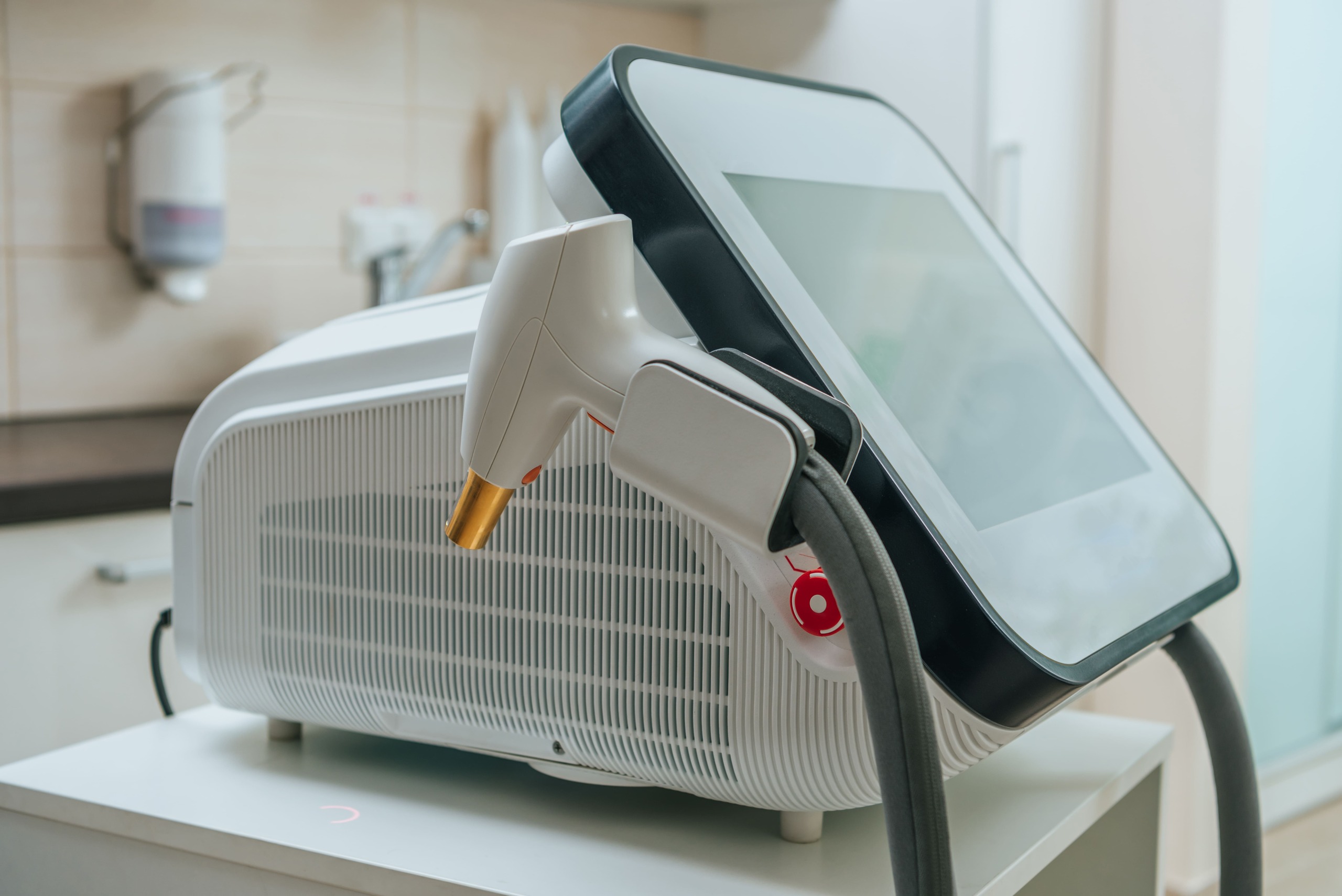
IPL, SHR and medical lasers differ in how light is produced or delivered to the hair follicle. IPL uses a flashlamp to emit broad-spectrum light, with filters selecting a useful range of wavelengths.
SHR, commonly expanded as Super Hair Removal, describes a technique that delivers repeated lower-energy pulses to heat the follicle gradually. It may be used with IPL or diode systems, so the term alone does not identify the light source.
Medical lasers use a specific wavelength. Hair-removal examples include alexandrite at 755 nanometres, diodes at around 800 to 810 nanometres and Nd at 1064 nanometres.
Which Option Suits Coarse Bikini Hair
Coarse, dark bikini hair commonly responds better to light-based treatment because it contains more melanin for the light to target. Response still varies with the device, settings, skin tone and hair characteristics.
A doctor may look at four hair features:
- Darker hair commonly provides more melanin for treatment light to absorb.
- Coarse hair commonly provides a larger pigmented target than very fine hair.
- Fine, blonde, red, grey or very light hair may respond poorly to light-based methods.
- Mixed hair colours or thicknesses may respond differently within the same area.
The bikini area commonly contains coarse, dark hair, but the skin may also be darker than surrounding areas. Hair and skin therefore need to be assessed together.
Speak with The Aesthetics Centre about bikini laser hair treatment if you want a doctor to assess how these characteristics may affect the treatment plan. Skin tone is the next part of that assessment.
Why Does Skin Tone Decide Which Device Is Used

Skin tone affects device and setting selection because melanin in the skin can absorb some of the same light intended for the hair. The Fitzpatrick scale helps describe skin by its typical response to sun exposure.
For laser hair treatment in the bikini area, the scale provides context rather than a stand-alone device instruction. The actual colour of the bikini-area skin also needs assessment.
| Type | Description | General Consideration |
| I | Pale skin that typically burns and does not tan | Lower skin melanin may create greater contrast with dark hair. |
| II | Fair skin that commonly burns and tans poorly | Hair colour and thickness may affect treatment response. |
| III | Skin that may burn initially and then tan | Skin and hair pigment both need assessment. |
| IV | Light brown skin that commonly tans easily | More skin melanin may affect wavelength and settings. |
| V | Brown skin that rarely burns and commonly tans deeply | Longer wavelengths may be considered because skin melanin absorbs them less. |
| VI | Dark brown or black skin with high melanin content | Skin pigment needs close consideration when wavelength and settings are selected. |
The 2025 StatPearls Fitzpatrick skin types table describes the six types by appearance and response to sun exposure. Bikini-area pigmentation may differ from other skin, so the treatment area still needs assessment.
That brings the options into a direct side-by-side comparison.
How the Options Compare Side by Side

IPL, SHR, Alexandrite, diode and Nd differ in light source, wavelength or delivery method, so suitability varies with skin and hair characteristics.
| Option | Light Source | How It Heats the Follicle | Commonly Considered For |
| IPL | Filtered broad-spectrum light | Filtered pulses transfer heat to melanin in the hair | Dark, pigmented hair when filters and settings suit the skin |
| SHR | May use IPL or diode systems | Repeated lower-energy pulses gradually build heat | Treatment plans where gradual repeated heating may be suitable |
| Alexandrite | 755 nm laser | A specific wavelength targets hair melanin | Commonly considered for lighter skin with dark hair |
| Diode | Around 800 to 810 nm laser | Heat is delivered to pigmented hair structures | May be considered across several skin types depending on settings |
| Nd | 1064 nm laser | Longer-wavelength light is absorbed less by skin melanin | Commonly considered when darker skin types need to be taken into account |
Settings, hair characteristics and bikini-area skin pigment may all affect the plan.
What Treatment in the Bikini Area Feels Like
In bikini laser hair removal, sensation varies by device, settings, cooling and individual sensitivity, and treatment is commonly described as warmth or a brief snapping feeling. Cooling may be used to manage heat at the skin surface.
Sensitivity varies in the bikini area, so experience differs from person to person. A pain ranking between IPL, SHR and medical lasers would not account for settings, cooling or individual sensitivity.
A doctor can explain what is typically expected with the proposed device and settings. The final choice still depends on the clinical assessment.
How the Right Option Is Chosen for You
The right option is chosen after a doctor assesses skin type, bikini-area pigmentation, hair colour and thickness, then considers which device and settings may be suitable. Suitability and the treatment plan are decided at a consultation with a doctor.
The assessment may include:
- the Fitzpatrick skin type and actual skin colour in the treatment area
- the colour, thickness and density of the bikini hair
- the contrast between hair pigment and surrounding skin pigment
- relevant health information for treatment planning
Continued regrowth may prompt reassessment of the device, settings or hair characteristics. A course of sessions is typically needed because hair grows in cycles, while the number required varies.
The Aesthetics Centre can discuss bikini laser hair treatment in relation to your skin tone, hair colour and hair thickness, and explain which treatment approach may be suitable.
You can also arrange a consultation to review your options with a doctor.
Frequently Asked Questions
Is SHR a Type of Laser?
SHR describes a treatment technique rather than one specific light source. It may be delivered by IPL or diode systems, so the device itself needs to be identified.
Does Light-Based Hair Removal Work on Fine or Light Bikini Hair?
Fine, blonde, red, grey or very light bikini hair may respond poorly because it contains less melanin. Dark, coarse hair commonly responds better, although individual results vary.
Is Laser Hair Removal Suitable for Darker Skin?
Laser hair reduction may be suitable for darker skin when wavelength and settings are selected after assessment. Longer wavelengths such as 1064 nm Nd are commonly considered for darker skin because skin melanin absorbs them less.
How Many Sessions Are Usually Needed?
A course of sessions is typically needed because hair follicles move through different growth phases. The number varies with the hair, skin, device, settings and response, so the treatment plan is decided and reassessed with a doctor.
Do Bikini Hair Reduction Results Last Indefinitely?
Results are described as long-term hair reduction, and the degree of reduction varies between individuals. Some hair may regrow over time, so a doctor can explain what may be expected after assessing the area.







Leave A Comment
You must be logged in to post a comment.